
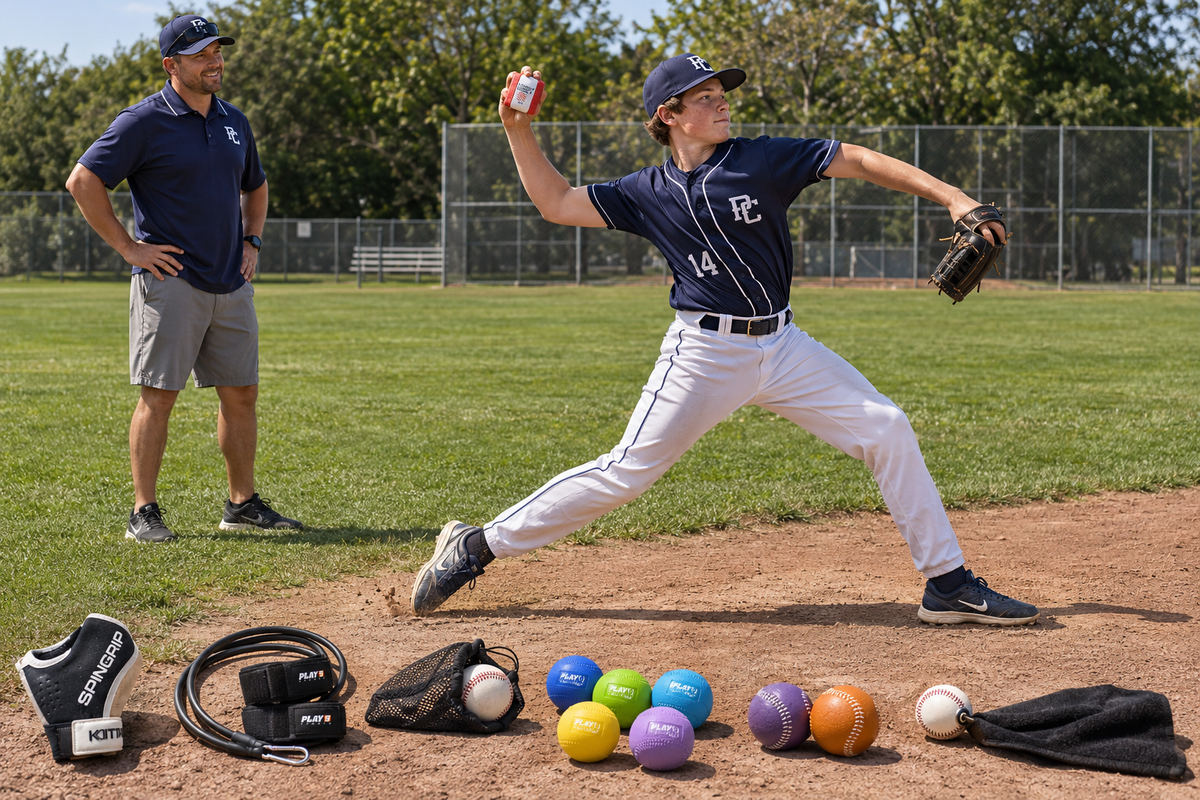
Resistance bands, plyo balls, throwing gloves, parachutes—there are plenty of ways to fill a player’s equipment bag. Choosing something that addresses a specific need takes a little more thought.
In our offseason throwing guide, we covered the foundations: rest, whole-body strength and a gradual return to throwing. Now let’s look at where training tools fit.
Start with one question: What is your player working on? Here are six options and the purpose each can serve.
1. SpinGrip: Practice Ball Position and Release
Does the ball sit deep in your player’s palm? Are they working on a more consistent release?
SpinGrip is worn on the throwing hand. Its palm spacer helps keep the ball in the fingers, giving players feedback on how they hold and release it during controlled catch.
It’s an option for pitchers and position players working on those specific skills. Choose the appropriate sport, size and throwing hand, then practice carrying the same feel into throws without the training aid.
Explore the SpinGrip Baseball Throwing Training Glove.
2. Resistance Bands: Add Structure to Arm Preparation
Bands provide resistance for exercises that can fit into a coached warm-up or strengthening routine. Wrist-strap versions let players perform movements without holding a handle.
They may suit players who already have an exercise plan and need portable equipment to follow it. Choose resistance the athlete can control throughout the prescribed movement.
Have a coach demonstrate the exercises and setup. Follow the anchoring instructions, keep the clip away from the face, and remember that a warm-up should prepare the player for throwing—not leave them exhausted.
See our Wrist-Strap Resistance Bands.
3. Mini-Chutes: Bring Parachute Resistance Into Throwing Practice
Mini-Chutes pairs a baseball or softball with an attached parachute. The parachute creates drag and shortens the ball’s flight, making it useful where throwing space is limited.
It may interest players whose coaches want to incorporate this type of training into an established throwing routine. Baseball and 11-inch and 12-inch softball versions are available.
Begin with controlled throws, follow the product’s instructions, and have a coach guide effort and workload. A shorter ball flight doesn’t mean the player should throw harder to reach a distant partner.
Explore the Mini-Chutes Resistance Throwing Trainer.
4. Plyo Balls and Leather Weighted Balls: Choose for a Specific Drill
These tools change the weight or feel of the ball, but their designs and intended uses differ.
Seamed plyo balls are designed for drills against an appropriate hard, flat surface. Leather weighted balls offer a more familiar ball covering in different weights.
Start with the drill and training plan before choosing the ball. Having several weights available doesn’t tell you which one your player should use—or how hard or how often they should throw it.
Discuss these tools with a qualified coach before buying, especially for a youth player. They belong in a planned routine with instruction and workload guidance.
Browse our Seamed Plyo Balls and 11-Inch Leather Weighted Softballs.
5. Performance Pitch: Rehearse Throwing Mechanics
Performance Pitch combines a small leather ball with a towel for drills focused on throwing direction, extension and follow-through.
It may suit a player whose coach has assigned towel drills and who wants a ball-like grip while practicing the movement.
Have the coach demonstrate the drill and identify one specific cue to work on. The goal is to rehearse that movement, then carry it into actual throwing.
See the Performance Pitch Training Ball.
6. Changeup Circle: Develop a Feel for the Changeup
Is your baseball pitcher working on a changeup but struggling to understand how the release should feel?
Changeup Circle is a cylindrical throwing trainer with finger recesses and a striped design that makes its flight easier to observe. It gives the player and coach visual feedback while they work on release feel.
Use it during controlled catch under a coach’s guidance, then alternate with a regular baseball to practice transferring that feel to the pitch.
It comes in 5-, 8- and 10-ounce options. Choose the model with your coach; heavier isn’t automatically better. Follow the manufacturer’s instructions, including using a glove to catch it and avoiding high-speed or long-distance throws with the weighted models.
Explore our Changeup Circle Training Tools.
Build a Routine Around Your Player’s Goals
These tools don’t have to be used in isolation. Different training aids can support different parts of the same development goal.
For example, a player working on ball position and release might use SpinGrip during controlled catch and incorporate coach-directed plyo-ball drills elsewhere in the routine. Each tool has a specific job. That doesn’t necessarily mean wearing SpinGrip while throwing plyo balls—using products together in one drill should follow their instructions and a qualified coach’s guidance.
Before adding equipment, ask:
-
What skill or movement are we working on?
-
How does each tool support that goal?
-
How will the drills fit together within the player’s planned workload?
The goal is a purposeful routine where every tool has a role. A coach can help connect the drills, manage throwing volume and check whether the work carries over to throwing a regular ball.
Explore our Throwing Training Collection, and check back here at Beyond the Dugout for individual product guides and ways to incorporate training tools into a structured routine.